
D-FantiX Battery Tester
4.5Editor score
No battery required to operate
Simple analog needle gauge
Affordable price point
Discover the best battery tester for household batteries to ensure reliability. This guide compares top models for accuracy, compatibility, and ease of use.
Keeping your household electronics running smoothly requires reliable power sources. A dedicated battery tester helps you quickly identify which cells still hold a charge and which need replacement. This tool saves money by preventing premature disposal of usable batteries.
We have evaluated ten leading battery testers available on the market today. Our analysis focuses on compatibility with common sizes, accuracy of voltage readings, and overall build quality. Each model offers unique features designed to simplify your battery maintenance routine at home.
Every product listed below includes detailed specifications and real-world performance insights. You will find options ranging from compact analog gauges to advanced digital readers with detailed displays. Please note that product availability and pricing may vary over time.
4.5Editor score

4.5Editor score

4.4Editor score
The following comparison table provides a side-by-side overview of all ten selected battery testers. Each entry highlights key specifications to help you choose the right tool for your specific needs and budget requirements.
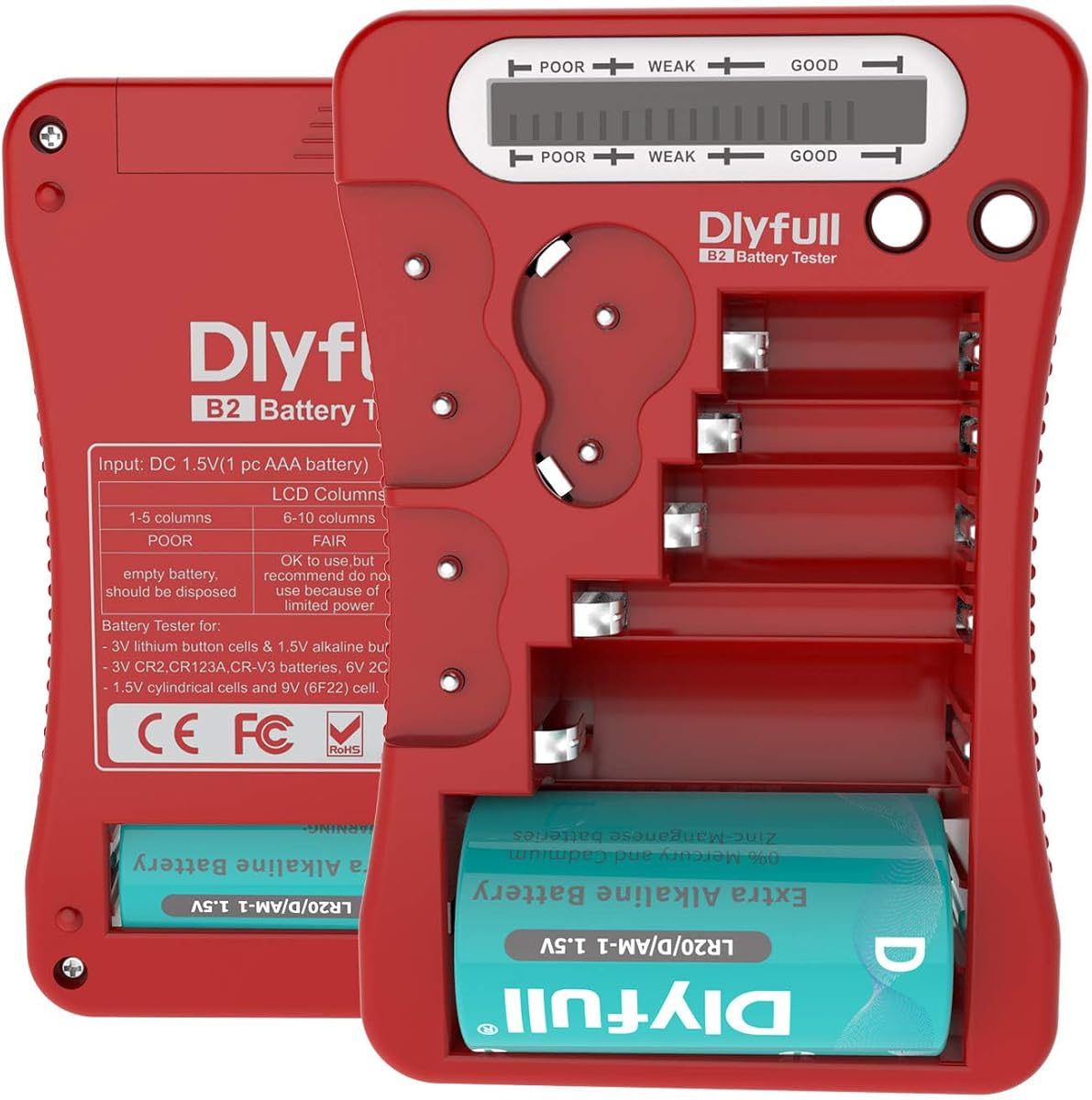


The Dlyfull Battery Tester stands out as a versatile tool for maintaining household electronics. It offers a high degree of compatibility with common battery sizes ranging from AA to 9V. The device provides clear results using an easy-to-read LCD screen that indicates battery health instantly.
We may earn a commission when you buy through this link, at no additional cost to you.
Its design prioritizes usability with a compact chassis that fits easily in drawers or toolboxes. The anti-slip finish ensures a firm grip during testing. The included AAA battery allows you to start testing immediately without needing additional purchases. Users appreciate the quick feedback that helps prevent waste.
While it does not support testing rechargeable batteries, this limitation keeps the device simple and affordable. The lack of backlit features might make it harder to use in dim lighting. However, for standard alkaline and primary cells, it delivers consistent and reliable readings.
This tester is ideal for homeowners who manage a variety of battery-powered devices. It helps identify weak cells before they fail completely. If you want a straightforward tool that balances performance with portability, the Dlyfull Battery Tester is a strong choice.
It supports AA, AAA, C, D, 9V, N, and various button cells like CR123A and CR2032.
The lightweight chassis features an anti-slip finish that makes it easy to hold and store.
We may earn a commission when you buy through this link, at no additional cost to you.
This Universal Battery Checker distinguishes itself with advanced real-load testing capabilities. Unlike basic voltage testers, it simulates actual usage to provide more accurate readings of battery health. It supports a wide array of batteries including rechargeable types often overlooked by simpler devices.
We may earn a commission when you buy through this link, at no additional cost to you.
The build quality is robust, featuring a steel construction that protects internal components. The LCD display shows exact voltage alongside a colored power bar for quick status checks. This combination of precision and durability makes it suitable for frequent use in workshops or homes.
Users should note that the screen lacks backlighting which may be inconvenient in low light. It also requires a AAA battery to operate which is not included. Despite these minor drawbacks, the depth of information it provides outweighs the cost for power users.
Choose this tester if you need detailed insights into battery performance under load. It is excellent for those who rely on rechargeable AA or AAA cells for power tools or devices. The comprehensive compatibility ensures it remains useful as your battery collection grows.
The device uses discharge resistors to simulate real device usage for accurate battery health assessment.
It uniquely tests 1.2V rechargeable AA, AAA, and AAAA batteries with specific discharge resistors.
We may earn a commission when you buy through this link, at no additional cost to you.
The D-FantiX Battery Tester offers a no-nonsense approach to checking battery levels without any internal power source. It activates simply by inserting the battery into the slot, making it a convenient tool for quick checks. The analog needle moves across a color-coded scale to indicate status.
We may earn a commission when you buy through this link, at no additional cost to you.
Its simplicity is its greatest strength. There are no screens to run out of power or settings to calibrate. This makes it highly reliable for basic home use where detailed voltage data is not necessary. The price point makes it accessible for everyone.
Because it relies on an analog display, readings might vary slightly based on viewing angle. It does not give exact voltage numbers which might be needed for professional diagnostics. However, it effectively tells you whether a battery is good, low, or needs replacement.
This tester is perfect for casual users who just want to avoid using dead batteries in devices. It saves money by preventing the disposal of partially charged cells. If you want a simple and cheap solution, this D-FantiX model delivers excellent value.
It requires no batteries to operate as it draws power directly from the battery being tested.
Works with standard household batteries including AA, AAA, C, D, and 9V types easily.
We may earn a commission when you buy through this link, at no additional cost to you.
This Dlyfull Battery Checker provides a reliable way to assess the health of standard household batteries. It features a crisp LCD screen that shows results through easy-to-interpret bars. The device is designed to fit comfortably in your hand thanks to an anti-slip finish.
We may earn a commission when you buy through this link, at no additional cost to you.
It covers a broad spectrum of battery types including cylindrical and button cells. This versatility ensures you can test most items in your home without needing multiple tools. The included AAA battery ensures it is ready to use right out of the box.
While it lacks the ability to test rechargeable cells, it performs its primary function efficiently for standard types. The compact size means it can be stored in a drawer or toolbox without taking up much space. Users appreciate the straightforward operation.
Consider this if you need a compact solution for checking batteries in remotes and flashlights. It helps maintain efficiency by ensuring you only use batteries that have sufficient charge. It is a solid choice for general household maintenance tasks.
The analyzer shows whether batteries are in poor, weak, or good condition of voltage clearly.
Its small and light chassis allows you to take it anywhere for on-the-go testing.
We may earn a commission when you buy through this link, at no additional cost to you.
The La Crosse Portable Digital Tester offers a straightforward way to view battery voltage numerically. It allows you to select specific voltage ranges such as 1.5V or 3.0V depending on the battery type. This ensures that the readings are accurate for the specific cells you are testing.
We may earn a commission when you buy through this link, at no additional cost to you.
Its sliding tray mechanism makes it easy to insert batteries in the correct orientation. The LED display provides immediate feedback on voltage and strength levels. It is particularly useful for checking both alkaline and rechargeable batteries efficiently.
The device is compact and fits well in a drawer for easy storage. However, the screen is small which might make reading numbers difficult for those with vision issues. It is a basic digital tester that covers essential needs without unnecessary complexity.
This model is great for users who prefer seeing exact numbers rather than bars. It helps in making informed decisions about whether to replace or reuse a battery. If you value digital precision in a small package, the La Crosse tester is a strong option.
Users can select 1.5V for alkaline or 1.2V for rechargeable batteries to improve accuracy.
Pulling the orange tray outward allows for safe insertion of batteries before testing.
We may earn a commission when you buy through this link, at no additional cost to you.
Buying this pack gives you two universal battery testers which is useful if you have multiple locations. These units operate without internal batteries meaning they are always ready when you need them. The design is lightweight and fits easily into your pocket for on-the-go checks.
We may earn a commission when you buy through this link, at no additional cost to you.
Testing is done by placing the battery in the correct slots and reading the indicator bars. This system provides a quick visual reference for battery health. It helps avoid the guesswork of whether a battery is still usable or dead.
Because it relies on simple mechanics, it may not be as precise as digital multimeters. The bars offer a general idea of power levels rather than exact voltage. However for home use this level of accuracy is often sufficient to prevent equipment failure.
This set is an excellent choice for households with many battery-operated devices. You can keep one in the kitchen and another in the garage. If you need reliable and affordable testing without ongoing battery costs, this pack offers great utility.
Requires no battery for operation so you never need to replace internal power cells.
Small and lightweight enough to take anywhere you go for quick checks on devices.
We may earn a commission when you buy through this link, at no additional cost to you.
The Tenergy T-333 is a small multi-purpose tester designed to handle a variety of household batteries. It features an LCD display that shows the status clearly. The device is compact enough to store in a drawer and includes a AAA battery to start testing.
We may earn a commission when you buy through this link, at no additional cost to you.
It works with popular sizes including AA, AAA, C, D, and 9V as well as specialty cells. This versatility makes it a convenient addition to any home toolkit. The low power product ensures it is a cost-effective tool for checking electronics.
While it lacks advanced features like rechargeable testing, it covers the basics well. The screen is not backlit so it is best used in well-lit areas. Its affordability and portability make it a popular choice for general use.
Choose this tester if you want a simple device to monitor battery health without breaking the bank. It helps you manage your battery inventory efficiently. If you need a reliable basic checker, the Tenergy model delivers consistent results.
Works with 12 different battery sizes ranging from AA to button cells.
Powered by only one AAA battery it uses minimal power for long-term operation.
We may earn a commission when you buy through this link, at no additional cost to you.
The Gardner Bender GBT-500A is a classic analog tester suitable for checking a wide range of batteries. It comes with test leads that allow for more flexible testing of batteries that do not fit in slots. This makes it useful for lantern and larger cell types.
We may earn a commission when you buy through this link, at no additional cost to you.
Its design focuses on durability and simplicity. The analog needle provides a clear visual indication of charge level across a calibrated scale. It supports 14 battery ranges which covers most household and specialty needs.
The inclusion of test leads adds versatility compared to slot-only testers. However the older design may lack the convenience of newer digital displays. It is a solid tool for professionals or hobbyists who prefer analog readouts.
This model is ideal if you work with various battery sizes in a workshop environment. The leads allow you to test batteries in situ without removing them. If you need a robust analog solution, the Gardner Bender tester is a dependable choice.
Included leads allow testing of batteries that do not fit directly into the main slots.
Supports 14 different battery ranges including 1.5V button cells and 12V lantern cells.
We may earn a commission when you buy through this link, at no additional cost to you.
This Dlypow Magnetic Tester introduces a unique magnetic design that holds the battery in place during testing. This feature ensures a stable contact for accurate readings. The simple one-step process makes it very user-friendly for people of all ages.
We may earn a commission when you buy through this link, at no additional cost to you.
The display is designed to be clear and easy to read without complex menus. It works with common household types such as AA, AAA, C, D, and 9V. The build uses premium materials to ensure long-term reliability and durability in daily use.
While the magnetic tip is convenient it may require cleaning over time to maintain strength. It does not provide exact voltage numbers which limits technical precision. However for sorting batteries it is highly effective and efficient.
Use this tester if you want a tool that simplifies the physical act of checking batteries. The magnetic hold prevents slipping and ensures consistent contact. If you value ease of use and durability, this magnetic model is a smart purchase.
The built-in magnetic tip grabs and holds the battery for a stable signal during measurement.
Designed for everyone with a simple process and large clear display for immediate results.
We may earn a commission when you buy through this link, at no additional cost to you.
This Battery Tester offers comprehensive compatibility with twelve battery types including various rechargeable chemistries. It features a sophisticated LCD display that shows both voltage and battery percentage. This dual format provides clear and precise information about the state of charge.
We may earn a commission when you buy through this link, at no additional cost to you.
The cylindrical batteries can be tested using the black negative pin while others fit into slots. The unit weighs less than 0.36 pounds making it extremely convenient to carry. It also includes a check button for self-testing to ensure its own battery level is adequate.
Users need to use 1.5V AAA alkaline batteries to power this product which may be an extra cost. It also includes a self-test process that requires holding the check button for seconds. These steps add a slight complexity compared to simpler analog tools.
Choose this if you want detailed percentage readings and broad support for rechargeable cells. It is helpful for managing complex battery needs in a home or office. If you value comprehensive data, this 12-type model is a powerful tool.
Battery level is presented in two formats as a percentage and battery level bar display.
Supports 12 types including 1.2V Ni-MH, 3.7V Li-ion, and 9V packs.
We may earn a commission when you buy through this link, at no additional cost to you.
Selecting the right battery tester depends on your specific needs and the types of batteries you use most often. Consider these factors to find a device that offers accuracy, durability, and ease of use for your household tasks.
Ensure the tester supports the battery sizes you use most such as AA, AAA, C, D, and 9V. Some models also include button cells or rechargeable options which adds versatility. Check the product specifications to confirm it covers all common types you have at home.
A wider compatibility range means you can use one device for all your needs. Look for testers that list specific chemistries like alkaline, lithium, and rechargeable Ni-MH to avoid surprises.
Digital displays show exact voltage numbers which are useful for precise diagnostics. Analog displays with colored zones are faster to read and often require no internal power. Consider your preference for numerical data versus quick visual status checks.
If you need to know if a battery is dead or alive quickly an analog display suffices. For technical accuracy, a digital screen provides the numbers you need to make informed decisions.
Some testers require an internal battery to operate while others are self-powered by the device being tested. Self-powered models are always ready but may offer fewer features like backlighting. Internal battery models often provide more advanced functions but need maintenance.
Choose a self-powered tester if you want simplicity and zero operating costs. Select an internal power model if you want features like digital readings and better screen visibility.
A durable build ensures the tester survives drops and frequent use in a toolbox. Look for sturdy materials like metal casings or reinforced plastic. Check for anti-slip finishes that make the device comfortable to hold during testing.
Investing in a well-built tester will save you from buying replacements often. A robust design ensures accuracy remains consistent over years of use in various environments.
The best testers are intuitive and require minimal setup before testing. Look for clear markings on battery slots and simple instructions. Avoid models with complex menus or calibration steps unless you need professional features.
A user-friendly design means you can test batteries quickly without frustration. Prioritize models that offer a one-step insertion and read process.
Standard voltage testers measure open circuit voltage which can be misleading. Load testers simulate actual usage to give a true picture of battery health. If you test rechargeable batteries or high-drain devices, this feature is critical.
Load testing ensures you do not discard a battery that looks full but drains quickly under stress. It provides a more reliable assessment of remaining capacity.
If you plan to take the tester on trips or to different rooms, portability matters. Compact models that fit in pockets or small drawers are ideal. Consider the weight and size when comparing different options.
A lightweight and compact tester is more likely to be kept handy. You can carry it easily to check devices whenever a battery seems to be failing.
Prices vary significantly between simple analog tools and advanced digital testers. Determine your budget and balance it against the features you need. Often mid-range models offer the best balance of cost and functionality.
Avoid overspending on professional features if you only need basic checks. Compare the cost against the benefits of better accuracy and compatibility to find value.
To begin using your battery tester, ensure the device has power if it requires internal batteries. For self-powered models simply insert the battery into the designated slot. Make sure the positive and negative ends align with the markings on the tester.
Read the display carefully to interpret the results. Digital models show exact voltage while analog ones use color codes. If a battery shows a weak or poor status, consider replacing it to prevent damage to your devices.
Store your tester in a dry place when not in use. Keep the battery slots clean by wiping them with a dry cloth. This maintains accuracy and prevents debris from interfering with electrical contact.
Most standard testers use very little current so they do not significantly drain the battery. However load testers draw more power to simulate real usage which may reduce the battery slightly. This effect is minimal and acceptable given the accuracy benefits it provides.
Some modern testers support 1.2V rechargeable batteries while others do not. Check the product specifications to confirm compatibility with Ni-MH or Li-ion cells. Using a compatible model ensures you get accurate readings for your rechargeable needs.
A low reading could indicate the battery is actually low or the tester needs maintenance. Check that the battery contacts are clean and the device has power. If the issue persists try a known fresh battery to verify the tester is working correctly.
Digital testers offer precise voltage numbers which are useful for technical diagnostics. Analog testers provide quick visual status indicators without needing internal power. The choice depends on whether you prioritize exact data or simplicity and reliability.
High-quality battery testers can last for many years if treated with care. There is no fixed replacement schedule unless the device shows signs of inaccuracy. Regularly test a known good battery to ensure your device remains calibrated and functional.
Many universal testers include slots or adapters for common button cells like CR2032. Always check the compatibility list before purchasing to ensure your specific button cells are supported. Proper testing prevents device malfunctions caused by low power cells.
Error codes usually indicate a problem with the battery connection or the device itself. Try cleaning the contacts or ensuring the battery is inserted correctly. If the error persists consult the user manual or consider replacing the tester for accurate results.
We reviewed ten top options ranging from simple analog gauges to advanced digital readers. The Dlyfull Battery Tester stands out for its balance of compatibility and ease of use. Each model offers unique benefits depending on your specific requirements.
Prioritize compatibility and display type when making your final decision. If you need exact voltage numbers choose a digital model. For quick checks a simple analog tester might be more than enough for your needs.
Prices and availability may change so check current listings before buying. Using a reliable battery tester helps you save money and extends the life of your electronics. Choose the one that best fits your home maintenance routine.