
ESP8266 ESP-01S
4.4Editor score
4MB Flash Memory
Compact Serial Transceiver
Supports AP and STA Modes
This guide compares the top 10 Arduino WiFi Module options for 2026, evaluating connectivity, processing power, and ease of use for diverse embedded projects.
Choosing the right Arduino WiFi Module is essential for building connected devices that communicate reliably over networks. Whether you are developing smart home gadgets or industrial sensors, the correct module ensures stable data transmission and efficient power management for your specific application needs.
We evaluated ten leading options based on wireless standards, processor speed, memory capacity, and compatibility with the Arduino ecosystem. Our analysis focuses on real-world performance metrics including signal strength, latency, and the ability to handle complex IoT tasks without external hardware dependencies.
Each pick highlights unique strengths like dual-core processing or integrated sensors to help you match hardware to your project goals. Please note that availability and stock levels may vary by region so always verify current inventory before starting your design process.
4.4Editor score

4.7Editor score

4.5Editor score
The following table provides a side-by-side comparison of the top Arduino WiFi Module options available in 2026. It highlights key specifications such as processor type, wireless capabilities, memory, and unique features to help you make an informed decision.



The Arduino UNO R4 WiFi stands out as the premier choice for advanced IoT projects requiring robust wireless capabilities and integrated peripherals. With a powerful 4.7 rating users appreciate its dual-core architecture combining the Renesas RA4M1 microcontroller and the ESP32-S3 chip for exceptional performance and flexibility.
We may earn a commission when you buy through this link, at no additional cost to you.
This board excels in applications demanding high-speed communications and real-time data processing. Its comprehensive wireless connectivity includes Wi-Fi and Bluetooth 5.0 ensuring stable links for remote sensors and smart devices. The 12-bit DAC and OP-AMP features provide precise analog signal generation ideal for audio and sensor interfacing.
While the board offers extensive features the learning curve might be steep for absolute beginners used to simpler setups. The integrated LED matrix and Qwiic connector simplify prototyping but add to the complexity. These trade-offs are acceptable for users needing advanced capabilities without external breakout boards.
Developers seeking a unified platform for complex IoT and embedded systems should prioritize this module. Its combination of processing power wireless connectivity and analog features makes it a versatile tool for professional and hobbyist projects alike.
Combining the Renesas RA4M1 and ESP32-S3 allows simultaneous handling of control tasks and wireless communication.
The built-in 12×8 LED matrix enables immediate visual status updates without external displays.
We may earn a commission when you buy through this link, at no additional cost to you.
This multi-pack offers three ESP8266 ESP-01 modules providing excellent value for projects requiring multiple wireless nodes. The ESP8266 chip delivers powerful on-board processing capabilities enabling efficient execution of complex tasks algorithms even on a small footprint.
We may earn a commission when you buy through this link, at no additional cost to you.
Supporting three modes including AP STA and AP+STA allows versatile networking options for diverse application scenarios. The LWIP compatibility streamlines development and enhances project compatibility within the Arduino ecosystem. This makes it suitable for smart grids intelligent transportation and industrial control fields.
The main drawback is the basic pinout design which can complicate wiring for complex projects. Additionally the rating of 4.2 suggests some units may vary in quality control. However for hobbyists needing multiple units at low cost these factors are manageable with careful selection.
Users looking to build sensor networks or distributed IoT systems will find this pack highly practical. It serves as a reliable foundation for prototyping where quantity and cost efficiency are key priorities.
Support for AP STA and AP+STA provides flexibility for different network topologies.
Three modules allow for redundant nodes or simultaneous testing without extra purchases.
We may earn a commission when you buy through this link, at no additional cost to you.
The ESP8266 ESP-01S is a favorite among budget-conscious makers needing reliable wireless connectivity with extra storage. Rated 4.4 it offers the latest version of the module featuring stronger signal performance and 4MB flash memory for more complex sketches.
We may earn a commission when you buy through this link, at no additional cost to you.
The 4MB flash allows for storing larger programs and data logs compared to older versions. Users must select Generic ESP8266 Module in Arduino IDE to program it correctly which ensures compatibility with various libraries. The stronger signal improves range and reliability in challenging environments.
However the module lacks level shifters meaning external circuitry is needed for 5V logic. Soldering is also required for reliable connections which adds to the build time. These challenges are common for this form factor and manageable for those with basic electronics skills.
For developers prioritizing cost and storage capacity this module is an ideal choice. It provides the core features needed for most IoT tasks without the premium price tag of more integrated boards.
4MB flash memory enables storage of larger code and logging data for advanced apps.
The latest version offers stronger signal strength for better connectivity range.
We may earn a commission when you buy through this link, at no additional cost to you.
This pack contains five ESP8266 ESP-01 modules providing a generous supply for large-scale prototyping or classroom use. The modules are compatible with Arduino and NodeMCU platforms supporting AT+ commands for flexible configuration and control.
We may earn a commission when you buy through this link, at no additional cost to you.
Users can employ these modules in smart grids intelligent transportation or smart furniture applications. The 1MB SPI flash is sufficient for standard WiFi tasks. Note that the item only supports 3.3V requiring careful power supply management to prevent damage.
The limitation on voltage tolerance means external logic level shifters are necessary for 5V systems. While basic these modules offer reliable performance for simple data transmission tasks. The bulk quantity ensures you have backups for experimentation and testing.
For bulk projects or educational settings this pack offers significant value. It allows teams to experiment with multiple nodes simultaneously while keeping costs low.
AT+ Commands allow for easy configuration and testing of WiFi settings.
Works seamlessly with Arduino and NodeMCU for versatile development workflows.
We may earn a commission when you buy through this link, at no additional cost to you.
The ELEGOO ESP-32 boards offer a significant upgrade with dual-core processing up to 240 MHz enabling complex sensor processing and wireless communication tasks. These boards are designed for responsive embedded and IoT projects requiring high performance.
We may earn a commission when you buy through this link, at no additional cost to you.
Built-in Wi-Fi and Bluetooth 4.2 support connectivity to networks and devices easily. The USB-C port simplifies power delivery and serial monitoring. Over-the-Air Update Support allows remote firmware changes without physical reconnection which is crucial for deployed devices.
One minor inconvenience is that the USB-C cable is not included in the package. Also the higher performance may consume more power than simpler modules. But the power-saving modes help mitigate this for battery-powered projects.
Projects needing robust processing and Bluetooth integration should consider these boards. The combination of speed and wireless features makes them suitable for sophisticated IoT applications.
OTA support enables firmware updates via WiFi without reconnecting hardware.
Dual-core 240MHz CPU handles complex logic and multitasking efficiently.
We may earn a commission when you buy through this link, at no additional cost to you.
The Arduino Nano ESP32 brings advanced features like MicroPython compatibility and HID support to the compact Nano form factor. Its ESP32-S3 chip provides dual-core Xtensa 32-bit LX7 processing for excellent power and efficient edge machine learning.
We may earn a commission when you buy through this link, at no additional cost to you.
Equipped with Wi-Fi and Bluetooth 5.0 connectivity ensures reliable low-latency data transfer. The USB-C port ensures faster programming and improved stability. These features make the board ideal for smart sensors and connected wearables.
Headers are not included requiring soldering for stable connections which might be a hurdle for beginners. The compact size is great for wearables but limits direct prototyping without breadboards. These are acceptable trade-offs for the performance and flexibility offered.
Developers wanting Python scripting and HID functionality should choose this board. It bridges the gap between ease of use and industrial-grade capabilities for embedded projects.
MicroPython compatibility simplifies rapid prototyping and interactive coding.
HID support allows creating custom keyboards and input peripherals easily.
We may earn a commission when you buy through this link, at no additional cost to you.
This pack of four ESP8266 ESP-01S modules is ideal for building sensor networks or wearable electronics. The modules are made of good material and can be reused multiple times making them durable for prototyping.
We may earn a commission when you buy through this link, at no additional cost to you.
The RF calibration ensures optimal performance for consistent wireless communication. Details include scenarios like home automation sensor networks and wireless location sensing devices. The self-calibrated nature reduces setup time for developers.
The package focuses on standard functionality which might lack advanced features like BLE or large flash. However for basic serial WiFi tasks it is highly effective. Users should verify voltage levels before connecting to 5V Arduino boards.
For distributed sensor systems this pack offers a cost-effective way to cover multiple points. Its focus on RF performance ensures reliable data transmission across various applications.
Self-calibrated RF ensures optimal performance for reliable connectivity.
Suitable for home automation wearable electronics and location sensing.
We may earn a commission when you buy through this link, at no additional cost to you.
This 5-pack provides ESP8266 ESP-01S modules with 4MB flash memory enabling data retention and retrieval for uninterrupted operation. The DOUT protocol ensures compatibility with standard SPI modes for easier programming.
We may earn a commission when you buy through this link, at no additional cost to you.
The high baud rate of 115200 supports fast data transfer. Documentation is provided for getting started which reduces initial confusion. Users must ensure 3.3V power only to avoid damaging the module.
As with other small modules soldering is required for stable connections. The high count supports teams or classes needing multiple units. The flash size is a key advantage for complex tasks requiring storage.
For projects needing multiple units with ample storage this pack is an excellent choice. It balances cost with performance for various Internet of Things WiFi applications.
115200 baud rate ensures quick data exchange between devices.
4MB flash allows complex data retention and logging capabilities.
We may earn a commission when you buy through this link, at no additional cost to you.
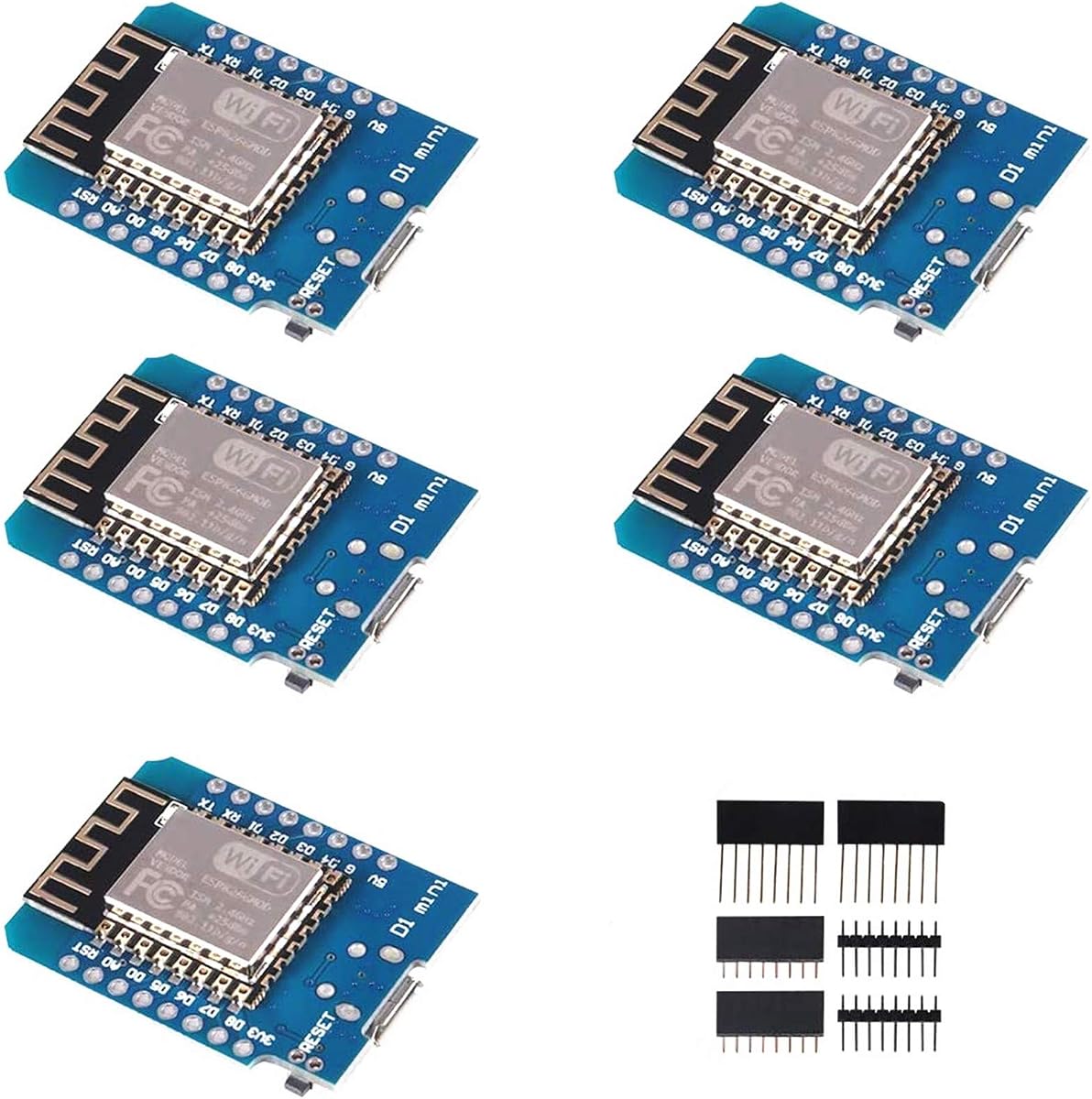
The D1 Mini is a compact NodeMcu board based on the ESP8266EX offering 11 digital I/O pins and PWM support. It is fully compatible with Arduino IDE and provides 4M Bytes of flash storage for Lua or C++ code.
We may earn a commission when you buy through this link, at no additional cost to you.
With Micro USB connection and a 500mA fuse it is safe and easy to power. The onboard switching power supply allows 5V 1A input which is convenient for many sensors. The pins are small but support I2C and interrupts.
The limitation is the Micro USB port which is becoming less common than USB-C. Also the small pin spacing might require fine pitch headers for reliable connections. These are minor issues for a compact development board.
For projects needing multiple I/O pins and a small footprint this board is ideal. Its compatibility with Arduino and Lua makes it versatile for various coding styles.
11 digital pins support PWM interrupts and I2C for diverse peripherals.
Integrated 500mA fuse protects against power surges during testing.
We may earn a commission when you buy through this link, at no additional cost to you.
This 10-pack provides a massive quantity of ESP8266 ESP-01 modules ideal for large deployment or extensive testing. The ESP8266 boasts robust on-board processing capabilities facilitating efficient execution of complex tasks and algorithms.
We may earn a commission when you buy through this link, at no additional cost to you.
Supporting AP STA and AP+STA modes provides versatile networking options. The compact yet potent solution allows integration into various projects. The 5.0 rating highlights user satisfaction with the quality and performance of these modules.
The basic functionality means external headers are usually needed for breadboarding. But the sheer number ensures you never run out for projects. The synergy with Arduino platforms streamlines development and compatibility.
For organizations or hobbyists needing multiple nodes this pack is the ultimate solution. It offers reliability and ease of development for wireless connectivity projects.
ESP8266 enables efficient execution of complex wireless algorithms.
Three WiFi modes allow flexible network setups for any scenario.
We may earn a commission when you buy through this link, at no additional cost to you.
Selecting the right Arduino WiFi Module requires evaluating several technical factors to ensure your project meets performance and budget needs.
Evaluate whether the module supports 2.4 GHz Wi-Fi Bluetooth 5.0 or 4.2. Modern projects benefit from Bluetooth for low-energy sensor connections while Wi-Fi ensures reliable cloud access. Check if the module includes dual-band support if you need to connect to different router frequencies.
Always verify the supported standards match your network infrastructure to avoid compatibility issues.
Look for modules with dual-core processors or high clock speeds such as 240 MHz to handle complex logic and simultaneous tasks. Single-core modules like the ESP8266 are sufficient for basic data logging but may struggle with heavy computations. Dual-core options allow dedicated cores for connectivity and logic.
Choose a processor that aligns with your application complexity to ensure smooth operation without lag.
Memory size determines how much code and data your module can store. Most basic modules offer 1MB which is enough for simple scripts. Larger applications requiring data logs or over-the-air updates should consider modules with 4MB or more to accommodate larger programs.
Ensure the flash size is sufficient for your longest expected firmware to prevent storage errors.
Most wireless modules operate at 3.3V logic levels meaning connecting them directly to 5V Arduino boards can damage the hardware. Look for built-in voltage regulators or level shifters to simplify integration. Power-saving modes are also crucial for battery-powered devices to extend operational life.
Check voltage specs carefully to match your power supply and reduce the need for external components.
Interfaces like UART SPI and I2C affect how easily you can connect sensors and displays. Serial modules are easiest for beginners as they use TX and RX pins. Advanced projects may need SPI for faster data throughput or I2C for multi-device networking on a single bus.
Select modules with interfaces compatible with your existing sensors to reduce wiring complexity.
Ensure the module supports the Arduino IDE or other platforms you prefer like MicroPython. Some boards include libraries for OTA updates which are essential for maintenance. A strong community and documentation help resolve issues quickly during development.
Prioritize modules with broad software support to streamline your workflow and reduce debugging time.
Compact modules like the ESP-01 are ideal for tight spaces but require soldering. Larger boards with headers simplify prototyping but take up more board space. Consider how you will attach the module to your project and whether breakouts or soldering are acceptable.
Choose a form factor that fits your enclosure while balancing ease of use and space constraints.
Individual modules are cost-effective for single prototypes but bulk packs reduce the unit price significantly for production. Evaluate the total cost of ownership including any extra components needed for power or voltage. Buying in packs ensures you have replacements for testing or future iterations.
Balance your budget by choosing packs that provide enough quantity without excessive waste for your specific needs.
Begin by installing the necessary drivers and libraries in your Arduino IDE or MicroPython environment. Ensure you select the correct board settings such as generic ESP8266 or ESP32 models to match your module. Configure the WiFi credentials in your code to establish a connection with your router.
Connect the module's power and logic pins securely using level shifters if operating at different voltages. Keep wires short to minimize interference and ensure stable signal transmission. Use a USB-C or Micro USB cable to upload sketches if your module includes a serial port.
Regularly check for firmware updates to improve performance and security. Store modules in a dry place when not in use to prevent oxidation on pins. Proper handling and soldering practices will extend the lifespan and reliability of your wireless setup.
The ESP32 offers dual-core processing Bluetooth connectivity and more GPIOs compared to the ESP8266. It also supports higher clock speeds and better security features. While ESP8266 is sufficient for basic WiFi tasks ESP32 is better for complex IoT projects needing Bluetooth or higher performance.
Yes many ESP32 and ESP8266 modules support MicroPython for easier coding. You must flash the MicroPython firmware onto the module first. Check the board's compatibility before selecting it for Python-based projects to ensure full library support.
Most modules operate at 3.3V so a regulator or level shifter is needed if your power source is 5V. Some boards have built-in regulators simplifying this step. Using a module with internal regulation reduces external component count and potential wiring errors.
Remote updates are achieved using Over-the-Air OTA support built into modern libraries. This allows you to send new code via WiFi without physical reconnection. Ensure your module supports OTA and configure the server correctly for smooth deployments.
Most modules use standard UART protocols making them compatible with various microcontrollers like Raspberry Pi or STM32. You must handle voltage logic levels correctly for safe communication. Check the pinout and voltage requirements before connecting to non-Arduino boards.
ESP32 provides dual-core processing Bluetooth integration and more GPIOs for complex projects. It supports modern security standards and has better power management for battery devices. The wider support and libraries make it a future-proof choice for advanced IoT development.
The Arduino UNO R4 WiFi stands out as the top overall choice for advanced features and integrated peripherals. For budget-friendly options the ESP8266 ESP-01S remains a reliable standard for basic connectivity needs. The Arduino Nano ESP32 offers premium capabilities including MicroPython support for flexible development.
Prioritize processor speed and memory size if your project involves complex data processing or multiple sensors. Ensure the wireless standards match your network setup and power requirements to avoid compatibility issues during deployment. Always check voltage levels to protect your components from damage.
Prices and availability fluctuate so verify current stock and specifications before purchasing. The right module depends on your specific project goals and technical comfort level. Invest in reliable hardware to ensure smooth operation and longevity for your connected devices.