
M-AUDIO Keystation 88 MK3
4.5Editor score
88 velocity-sensitive semi-weighted keys
Plug-and-play USB connectivity
Includes MPC Beats and Ableton Live Lite
This guide compares the top 88 key weighted MIDI controllers for musicians and producers, evaluating key action, features, and integration for your studio
Finding the right 88 key weighted MIDI controller is essential for pianists and producers who demand authentic feel and precise control over their virtual instruments.
We evaluated ten top models based on key action quality, connectivity options, software integration, and overall build to help you find the perfect match for your workflow.
Each pick below highlights specific strengths and weaknesses so you can decide which controller fits your budget and style, keeping in mind that prices may fluctuate over time.
4.5Editor score

4.6Editor score

4.3Editor score
The following comparison table provides a side-by-side look at the key specifications and standout features of each controller to help you make an informed decision quickly.



The M-AUDIO Keystation 88 MK3 stands out as a reliable entry point for musicians seeking a full-range MIDI controller without breaking the bank. With a solid 4.5 star rating from users, it delivers consistent performance for recording and live settings.
We may earn a commission when you buy through this link, at no additional cost to you.
Its 88 velocity-sensitive semi-weighted keys provide a responsive playing surface that works well with software instruments and samplers. The inclusion of a volume fader, transport buttons, and pitch and modulation wheels ensures you have essential controls at hand for expressive performances.
While it lacks the tactile feedback of a fully weighted hammer action, the lightweight design makes it easy to move between home studios and stages. The plug-and-play USB connectivity means you can start creating music immediately without installing extra drivers or worrying about power supplies.
This controller is ideal for beginners or producers who prioritize simplicity and value. If you need a straightforward tool to trigger virtual instruments and control your DAW without complex setup, the Keystation 88 MK3 is a strong recommendation.
The USB connection works natively with Mac and PC systems and supports iOS devices with an adapter, ensuring broad compatibility across various studio configurations.
Included software like MPC Beats and Ableton Live Lite gives you immediate access to production tools, helping you start making music right out of the box.
We may earn a commission when you buy through this link, at no additional cost to you.
The M-AUDIO Hammer 88 Pro targets pianists who demand a realistic touch from their MIDI controller. Featuring graded hammer action weighted keys, it mimics the feel of an acoustic piano with more resistance in the lower keys and lighter touch in the higher register.
We may earn a commission when you buy through this link, at no additional cost to you.
It offers extensive control options including 16 velocity-sensitive drum pads, 8 assignable knobs, and 9 faders for managing your DAW and plugin parameters. Native Kontrol Standard support allows you to browse and control Native Instruments presets directly from the controller for a streamlined workflow.
Users appreciate the inclusion of three complementary NKS bundles which provide access to sound libraries right away. The Smart Chord and Scale modes also help unlock creative possibilities for those exploring new harmonic ideas during composition.
This controller is best suited for producers who work heavily with Native Instruments software or need a high-end feel without spending flagship prices. While some users report mixed experiences with long-term durability, its feature set offers significant value for serious production work.
The partnership with Native Instruments brings NKS support to the table, making it easier to manage presets and sound libraries without switching between the mouse and keyboard.
With 9 assignable faders and 8 knobs, you can map controls for mixing, effects, and automation, giving you a tactile experience that enhances your studio sessions.
We may earn a commission when you buy through this link, at no additional cost to you.
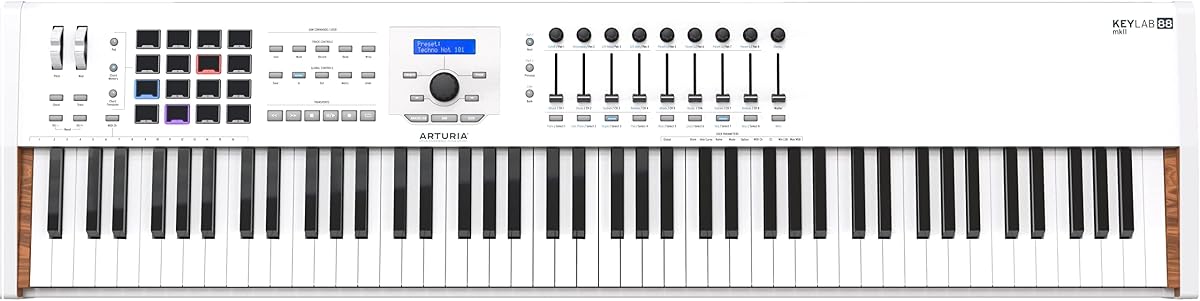
The Arturia KeyLab 88 mk3 represents a modern approach to full-size MIDI controllers with a focus on quality and versatility. The fully weighted hammer-action keys offer a professional playing experience that appeals to classical pianists and producers alike.
We may earn a commission when you buy through this link, at no additional cost to you.
It comes equipped with 12 pressure-sensitive performance pads that add a dynamic layer to your performances allowing for expressive drum programming and sample triggering. The USB-C power ensures reliable connectivity on newer computers and mobile setups without needing extra adapters.
Arturia includes a sheet music stand which is a thoughtful addition for those who reference scores while playing. The keyboard also integrates well with DAWs and comes with a software package that enhances your production capabilities from the start.
This model is perfect for musicians who need a durable and expressive controller for both studio and stage. While the price is higher than basic options, the build quality and feature set justify the investment for serious artists seeking a premium instrument.
The combination of 88 hammer keys and 12 pressure pads offers a wide range of expressive options for detailed musical performance and creative control.
USB-C power simplifies connections and aligns with current industry standards, making it easier to integrate with modern laptops and mobile devices.
We may earn a commission when you buy through this link, at no additional cost to you.
The white variant of the Arturia KeyLab 88 mk3 offers the same professional features as the black model but with a striking aesthetic that can brighten up any studio setup. It retains the fully weighted hammer-action keys that define the series.
We may earn a commission when you buy through this link, at no additional cost to you.
Its 12 pressure-sensitive performance pads provide dynamic control over drums and samples, while the USB-C power ensures compatibility with modern systems. The inclusion of a sheet music stand makes it practical for composers who work with scores.
Users who choose this model often appreciate the clean look and the quality of the key action. However, some feedback suggests that the finish may require more maintenance to keep looking new in a dusty environment.
This controller is ideal for artists who value both performance and appearance. If you are looking for a premium hammer-action controller that stands out visually and delivers on functionality, the white KeyLab 88 mk3 is a compelling choice.
The white finish provides a unique look that complements modern studio designs, offering both style and substance for professional environments.
Despite the color change, the underlying technical specifications remain robust, ensuring reliable performance across all production scenarios.
We may earn a commission when you buy through this link, at no additional cost to you.
The Novation Launchkey 88 [MK3] is widely recognized for its seamless integration with Digital Audio Workstations. This makes it a top choice for producers who want to control their software directly from the keyboard without complex mapping.
We may earn a commission when you buy through this link, at no additional cost to you.
It features 88 premium semi-weighted keys and 16 velocity-sensitive pads that allow you to play with feeling. The arpeggiator with Strum Mode adds a rhythmic dimension to your melodies while the Scale and Chord modes help even beginners create complex harmonies.
Custom Modes allow you to take control of your favorite synths and hardware beyond the DAW which increases its flexibility. The controls are laid out intuitively to ensure that you stay focused on creativity rather than troubleshooting settings.
This controller is highly recommended for anyone working primarily within a computer-based production environment. If your workflow relies heavily on DAW features and you want a controller that simplifies that process, the Launchkey 88 is an excellent investment.
The arpeggiator and chord modes unlock new melodic and rhythmic possibilities, making it easier to explore fresh ideas during songwriting sessions.
With Custom Modes and MIDI output options, you can adapt the controller to fit various hardware setups ensuring it grows with your studio.
We may earn a commission when you buy through this link, at no additional cost to you.
The Studiologic SL88 MK2 is designed for musicians who need a reliable 88-key controller without the bulk of traditional weighted models. It offers a balanced weighted action that feels responsive while maintaining a relatively light footprint for touring.
We may earn a commission when you buy through this link, at no additional cost to you.
The onboard display provides immediate feedback on your settings and parameter changes which is useful when adjusting sounds on the fly. With 7 encoders, you have plenty of control over your parameters for mixing or sound design tasks.
Compatibility with Numa Player software adds an extra layer of versatility allowing you to load your own sounds. This makes it a versatile tool for both production and live performance scenarios where you need to customize your setup.
This controller is well-suited for gigging musicians or producers who value portability without sacrificing key range. If you need a controller that can adapt to different environments and software setups, the SL88 MK2 is a strong contender.
The lightweight build ensures you can transport it easily while the 88 keys provide the full range needed for professional compositions.
Seven encoders allow for deep control over your tracks and plugins making it easier to manage complex projects during recording.
We may earn a commission when you buy through this link, at no additional cost to you.
The YAMAHA P71 is primarily a digital piano but functions well as a MIDI interface for those who prioritize touch over software features. Its weighted action keys replicate the experience of an acoustic piano making it ideal for practice and performance.
We may earn a commission when you buy through this link, at no additional cost to you.
You can choose from 10 unique voices including the rich resonance of a Yamaha grand piano which adds variety to your sound. The Dual Mode allows you to blend two voices for a layered experience that enriches your performances.
While it includes a sustain pedal for greater expression, it lacks the extensive controls found on dedicated MIDI controllers like faders or knobs. However, its simplicity means you can focus entirely on playing without getting distracted by buttons.
This model is perfect for pianists who want a high-quality instrument for both home use and basic recording. If your main goal is to enjoy an authentic piano feel with reliable sound quality, the P71 is a trusted choice.
The weighted keys provide a realistic tactile experience that helps develop proper technique for acoustic piano performances.
Dual Mode lets you combine sounds like piano and strings to create a rich palette for your musical arrangements.
We may earn a commission when you buy through this link, at no additional cost to you.
The Arturia KeyLab Essential mk3 is designed to bridge the gap between entry-level and professional MIDI controllers. It features a hybrid synth-piano feel that allows for expressive playing across a full 88-key range.
We may earn a commission when you buy through this link, at no additional cost to you.
New creative features like Scale Mode and Chord Mode make composition more intuitive for beginners while the included Analog Lab Pro provides access to over 2000 presets. The RGB-backlit pads add visual feedback that enhances the user experience.
It offers custom scripts for DAW integration ensuring that control is streamlined for various software environments. This reduces the setup time and allows you to get started with production more quickly after unboxing.
This controller is ideal for aspiring musicians and producers looking for a comprehensive package. If you want a controller that helps you learn and create with powerful software included, the KeyLab Essential mk3 is a great starting point.
Scale and chord modes simplify the composition process allowing you to experiment with complex harmonies without deep music theory knowledge.
With Analog Lab Pro included, you have instant access to a vast range of sounds from vintage synths to modern orchestral textures.
We may earn a commission when you buy through this link, at no additional cost to you.
The Arturia KeyLab 88 MkII is a comprehensive controller designed for professional studio environments. Its Fatar TP/100LR keybed ensures a durable and expressive playing experience that stands up to frequent use.
We may earn a commission when you buy through this link, at no additional cost to you.
The control bank with 9 faders and 9 rotary knobs provides extensive tactile control over your virtual instruments and effects. The 16 RGB-backlit performance pads allow for dynamic drum programming and clip launching within your DAW.
Inclusion of Analog Lab V software adds significant value by providing thousands of high-quality sounds to explore. The aftertouch and velocity sensitivity give you the nuance needed to craft detailed and emotive performances.
This controller is best suited for producers who need full control over their software from a single surface. If you want a robust tool that combines high-quality keys with extensive control options, the KeyLab 88 MkII is a reliable choice.
The Fatar keybed is a standard for professional keyboards ensuring that the keys remain consistent over years of heavy use.
With 9 faders and knobs you can mix tracks and adjust effect parameters without lifting your hands from the keyboard.
We may earn a commission when you buy through this link, at no additional cost to you.
The Roland A-88MKII focuses on unmatched playability with its PHA-4 keyboard action which is highly regarded for its realistic feel. The construction uses wood and premium materials ensuring it is built to last for years of dependable performance.
We may earn a commission when you buy through this link, at no additional cost to you.
It features a thin design with shallow depth to fit comfortably in today's studio environments. The onboard arpeggiator and chord memory provide tools for creating melodies and harmonies on the fly during composition sessions.
With eight RGB-lit assignable knobs and pads it offers customizable control for your production needs. The USB-C connectivity and bus power simplify setup while its readiness for MIDI 2.0 ensures compatibility with future standards.
This controller is perfect for musicians who prioritize the quality of the key action above all else. If you want a durable and responsive instrument that feels like a piano the Roland A-88MKII is a top-tier option.
The PHA-4 keyboard provides unmatched playability that appeals to pianists seeking a natural feel during performance.
MIDI 2.0 readiness ensures that your controller will support advanced features as the industry evolves keeping it relevant longer.
We may earn a commission when you buy through this link, at no additional cost to you.
Choosing the right 88 key weighted MIDI controller involves evaluating several key factors to ensure it meets your musical needs and studio setup requirements.
Key action determines how the keys feel when you play. Weighted hammer-action keys mimic an acoustic piano with heavier resistance while semi-weighted keys offer a lighter feel that is easier to play quickly.
Choose hammer-action if you are a pianist or need realistic dynamics. Semi-weighted is better for synth leads and electronic music production.
Velocity sensitivity detects how hard you press a key to change volume or brightness. All 88 key controllers include this feature but some offer finer control for dynamic expression.
Ensure the controller offers multi-level velocity detection for nuanced performances that sound professional in your mixes.
Aftertouch allows you to modulate sound after the key is pressed. This can add vibrato or filter changes without needing a separate controller.
Look for controllers with aftertouch if you plan to use expressive plugins or want to add movement to your sounds easily.
Many modern controllers come with scripts that map controls to specific Digital Audio Workstation functions. This saves time on setup and makes production smoother.
Check if the controller supports your specific DAW software to maximize convenience during recording and mixing sessions.
An 88-key controller is larger than smaller models and can take up significant desk space. Consider the footprint and weight if you plan to transport it often.
Choose a model with a slim design if you have limited space or need to move it between gigs frequently.
Connectivity includes USB, MIDI ports, and pedal inputs. USB is standard for computers but MIDI 5-pin ports are useful for hardware integration.
Ensure the controller has the necessary inputs for sustain pedals and expression pedals to expand your control options.
Many controllers come bundled with DAWs and virtual instruments. These can provide immediate value and reduce your initial software costs.
Check the included software to see if it aligns with your production needs before making a purchase.
Prices for 88 key controllers range widely based on features and build quality. Higher-end models offer better key action but cost more.
Set a budget that balances your financial constraints with the features you need for your workflow.
Connect your controller to your computer via USB and install any required drivers. Launch your DAW and assign the controller in the MIDI settings to ensure it sends signals correctly.
Calibrate the velocity sensitivity if your controller supports it. This ensures that the response to your playing style is accurate and consistent across the key range.
Keep the keys clean by using a soft dry cloth regularly. Avoid exposure to direct sunlight or moisture which can damage the sensitive electronics and key mechanisms.
Semi-weighted keys are lighter and easier to play quickly making them suitable for synth leads and electronic music. Hammer-action keys mimic an acoustic piano with heavier resistance which is ideal for pianists and dynamic performances.
Most modern controllers use USB bus power so you do not need an extra adapter. However some premium models may require a separate power supply for full functionality of all features.
Yes many controllers are compatible with iPad via an Apple to USB Camera Adapter. Ensure your controller supports USB MIDI class compliance for plug-and-play functionality without drivers.
Yes weighted controllers help beginners develop proper finger strength and technique. They are especially recommended if you plan to learn piano or need realistic dynamics for your productions.
Controllers often include DAWs like Ableton Live Lite and plugins like MPC Beats. These bundles provide a starting point for production and sound design without extra cost.
Start by checking the USB connection and restarting your DAW. Update drivers if available and try connecting to a different port. If keys still fail, you may need to contact customer support.
MIDI 2.0 allows for more detailed data transmission and expressive control. It is a future-proof option that supports higher resolution and better integration with advanced plugins.
Yes many controllers can connect to hardware synths or mobile devices directly via MIDI. This allows for standalone performance or recording without needing a computer setup.
We have reviewed ten top 88 key weighted MIDI controllers ranging from budget-friendly options to premium professional models. Each offers unique strengths that cater to different musical styles and production needs.
When choosing, prioritize key action feel and DAW integration to ensure the controller supports your workflow effectively. Consider your budget and the included software to maximize value from your purchase.
Remember that prices and availability may change over time. Check current listings and reviews before buying to ensure you get the best deal for your specific studio requirements.