
Akai Professional LPD8 USB MIDI Pad Controller
4.4Editor score
8 RGB-backlit MPC drum pads
8 assignable Q-Link knobs
Lightweight portable design
Explore the top pad controllers for beat making in October 2026. This guide compares features, compatibility, and build quality to help you choose the perfect
Choosing the right pad controller for beat making can transform your music production workflow. These devices offer tactile control over samples, loops, and virtual instruments, allowing you to focus on creativity rather than mouse clicks. Whether you are a beginner or a professional producer, finding the right tool is essential.
We have evaluated ten top-rated MIDI pad controllers based on performance, build quality, and software integration. Each product was assessed for its responsiveness, portability, and compatibility with popular digital audio workstations. Our goal is to provide a comprehensive overview to help you make an informed decision.
Each pick highlights key features, pros, cons, and ideal use cases for different types of creators. Prices and availability can change frequently, so please verify current details before purchasing. This guide is updated regularly to reflect the latest technology and user feedback in the music production community.
4.4Editor score

4.4Editor score

4.6Editor score
This side-by-side comparison highlights the key specifications and unique selling points of each pad controller on our list. Use this table to quickly identify which device aligns best with your specific production needs and budget constraints.



The Akai Professional MPD218 stands out as a top-tier MIDI pad controller for beat makers who need reliable hardware. It features 16 thick fat MPC pads that offer a satisfying tactile response, making it ideal for drum programming and live performance triggering. With a rating of 4.4 stars, it is trusted by many producers for its durability and functionality.
We may earn a commission when you buy through this link, at no additional cost to you.
Its standout quality is the combination of physical controls and software integration. The 18 fully assignable 360-degree potentiometers allow deep control over DAW parameters, while the MPC Beats software provides a complete production environment. This makes it a versatile tool for both studio recording and live set preparation without needing extra gear.
While highly capable, it lacks some modern conveniences like a dedicated touch strip for volume control. Additionally, fully leveraging the software suite requires initial configuration which might be overwhelming for absolute beginners. However, these trade-offs are minor compared to the overall value and control it provides.
Producers seeking a balanced, high-quality controller with proven MPC heritage should choose this device. It is perfect for those who want to replicate the classic MPC workflow without investing in expensive standalone hardware. This recommendation holds for both home studios and professional setups.
The 16 thick fat MPC pads provide a high-quality tactile experience that mimics the feel of standalone MPCs, ensuring accurate timing and dynamic control.
Includes MPC Beats, Ableton Live Lite, and other tools, giving users a full production suite right out of the box to start making music immediately.
We may earn a commission when you buy through this link, at no additional cost to you.
The PreSonus ATOM is designed to bridge the gap between screen and hardware with tight integration into Studio One and Ableton Live. It features 16 full-size velocity and pressure-sensitive RGB pads that offer expressive control over virtual instruments and loops. Its 4.3-star rating reflects user satisfaction with its comprehensive feature set for production and performance.
We may earn a commission when you buy through this link, at no additional cost to you.
Key strengths include the ability to customize pad velocity curves and pressure thresholds for maximum expressiveness. The inclusion of 20 assignable buttons and 4 endless rotary encoders allows for deep control over effects and mixer settings. It also comes with significant software value, including Studio Magic Plug-In Suite and MVP Loops content.
On the downside, the device is somewhat heavier and bulkier than compact controllers, making it less ideal for frequent travelers. While versatile, some users may find the setup process for deep integration slightly involved. These factors are generally acceptable given the robust functionality offered at this price point.
Studio One users and those needing extensive hands-on control over their DAW will find this controller valuable. It suits producers who prioritize detailed customization and are willing to trade portability for a richer feature set. This is a solid investment for stationary or home studio setups.
Pressure-sensitive pads allow for nuanced control over parameters like filter cutoff or volume, adding a new layer of expressiveness to your performances.
Comes with Studio One Artist and over $1000 of plug-ins, providing a complete recording environment to get started without additional purchases.
We may earn a commission when you buy through this link, at no additional cost to you.
The Akai APC Mini MK2 is arguably the best choice for Ableton Live users seeking a grid-style controller. It features a 64 RGB pad matrix that provides visual color feedback for clip launching, making live performance intuitive. With a high rating of 4.6 stars, it is highly regarded for its seamless integration and build quality.
We may earn a commission when you buy through this link, at no additional cost to you.
Its main advantage is the 1-to-1 integration with Ableton Live, allowing you to launch clips and scenes with ease. The 9 assignable faders give you hands-on control over volume, pan, and devices, reducing reliance on your mouse. Smart Scale View in Note mode makes playing melodies visually effortless for beginners and pros alike.
However, its functionality is most optimized for Ableton Live, which might limit its utility with other DAWs. Not all pads are velocity-sensitive, which could be a drawback for certain performance styles. These limitations are acceptable considering the specialized design and high performance within its intended ecosystem.
Ableton Live performers and producers should choose this device for its unmatched workflow integration. It is ideal for live sets and creative looping where visual feedback and quick access are paramount. This recommendation is strong for anyone dedicated to the Ableton ecosystem.
The 64 RGB pads provide instant visual confirmation of clip status, making complex live sets easier to manage without looking at the screen.
Nine assignable faders allow for direct mixer control, enabling real-time mixing and automation adjustments during performances or recording.
We may earn a commission when you buy through this link, at no additional cost to you.
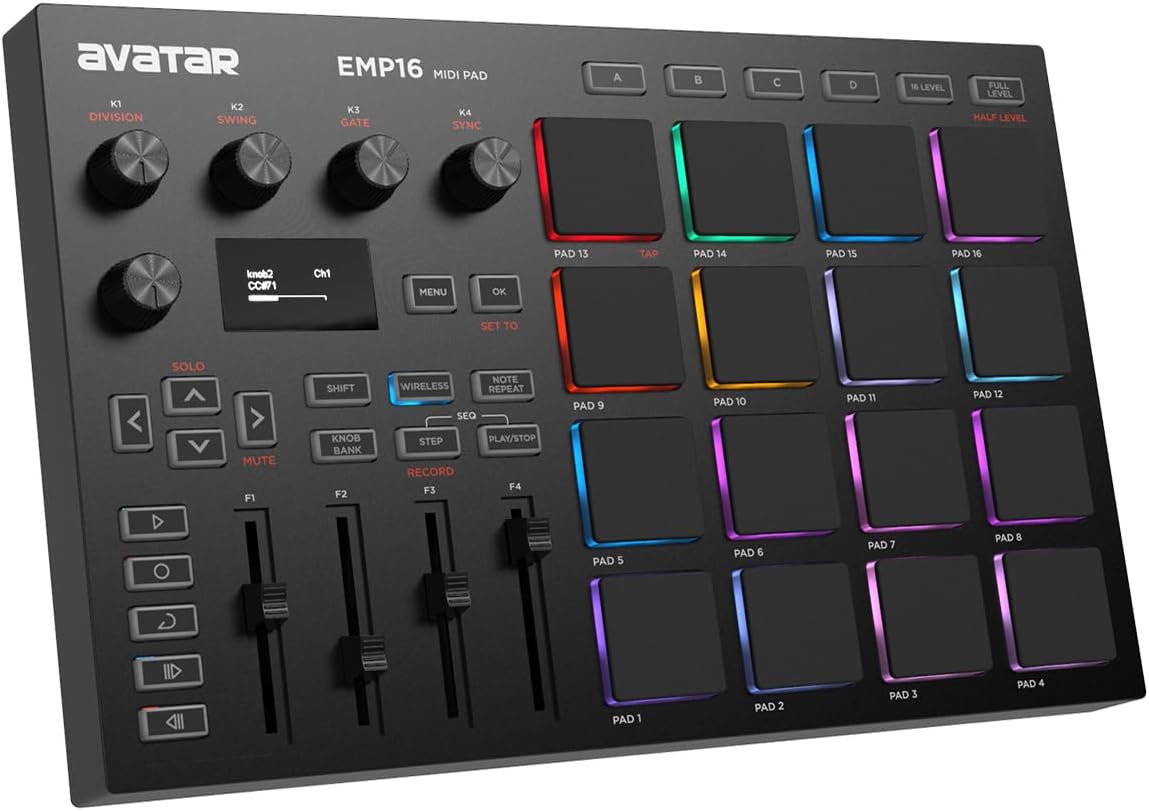
The EMP16 MIDI Pad Controller distinguishes itself with genuine Bluetooth 5.0 connectivity for wireless DAW control. This makes it perfect for mobile production on iPad or iPhone without needing cables or adapters. Its 4.2-star rating reflects user appreciation for its portability and extensive assignable controls in a compact package.
We may earn a commission when you buy through this link, at no additional cost to you.
Key features include 16 RGB illuminated pads with customizable colors and 3 velocity curves for expressive control. The 4 assignable faders and OLED display provide visual feedback for settings without needing a PC editor. It also supports standard MIDI inputs and outputs for integration with outboard gear.
Drawbacks include the need to purchase batteries separately if not using USB power, which can be an inconvenience. The feature density might be overwhelming for beginners who prefer simpler interfaces. Despite this, the flexibility and wireless freedom make it a strong contender for mobile creators.
Mobile producers and iPad users looking for wireless freedom will benefit most from this controller. It is suitable for those who need to produce beats anywhere without cable constraints. This is a great choice for modern, untethered workflows.
Bluetooth 5.0 connectivity allows seamless connection to iOS and Mac devices without cables or adapters, enabling true mobile production capabilities.
The OLED display provides instant visual feedback on settings, making it easy to adjust parameters on the fly without software editors.
We may earn a commission when you buy through this link, at no additional cost to you.
This Mini Wireless MIDI Controller is designed for creators who need reliable, cable-free music production on the go. It features 16 RGB velocity-sensitive pads with aftertouch, allowing dynamic modulation of notes and effects. With a 4.2 rating, it offers a solid balance of portability and expressive functionality for mobile setups.
We may earn a commission when you buy through this link, at no additional cost to you.
Its standout feature is the built-in rechargeable battery providing up to 15 hours of continuous use. The ability to connect via Bluetooth MIDI ensures you can work from anywhere without worrying about power sources. Customization is handled via a mobile app, allowing you to tailor pads and commands to your specific DAW.
The compact design means the pads are smaller than standard size, which might take adjustment for some users. Full feature unlocking requires using the KuSuite app or desktop software, adding a step before use. These factors are minor compared to the convenience and mobility it provides.
Traveling musicians and DJs needing a lightweight controller for live remixing will find this highly practical. It is ideal for those prioritizing battery life and wireless connectivity in a small form factor. This recommendation fits the needs of modern mobile creators.
With up to 15 hours of continuous use, this controller ensures your session stays uninterrupted even during travel or outdoor performances.
Aftertouch functionality allows dynamic control over effects and modulation, adding depth and nuance to your live performances.
We may earn a commission when you buy through this link, at no additional cost to you.
This Wireless MIDI Controller Pads offers a compelling package for beat makers looking for affordability and wireless functionality. With a perfect 5.0 rating, it is praised for its ease of use and reliable Bluetooth MIDI performance. It features 16 velocity-sensitive RGB pads that are responsive enough for accurate drum programming and triggering samples.
We may earn a commission when you buy through this link, at no additional cost to you.
Key strengths include a 20-hour battery life that supports extended sessions without interruption. The inclusion of 8 assignable knobs and 6 customizable buttons provides sufficient control over DAW parameters and effects. It works with major software like Ableton Live and Logic Pro, making it versatile for various workflows.
The build materials feel somewhat basic compared to premium controllers, which may affect long-term durability. Documentation and software support are minimal, so you may need to rely on trial and error for mapping. However, for the price, it delivers excellent value and performance for entry-level users.
Beginners and casual producers seeking an affordable wireless solution should consider this controller. It is suitable for those wanting to simplify their setup without investing heavily. This is a high-value option for entry-level mobile production.
Up to 20 hours of continuous use ensures you can work on creative projects throughout the day without recharging.
Works seamlessly with major DAWs and mobile apps, providing a smooth plug-and-play experience across different production setups.
We may earn a commission when you buy through this link, at no additional cost to you.
The Akai MPK Mini IV expands beyond a simple pad controller by adding 25 mini keys alongside 8 MPC pads. This hybrid design makes it perfect for users who need both chord input and sample triggering. Its 4.6 rating indicates high satisfaction with its advanced performance tools and modern connectivity options.
We may earn a commission when you buy through this link, at no additional cost to you.
Key features include 360-degree assignable knobs and a full-color screen for intuitive navigation of presets and settings. The NKS integration allows for instant loading of Native Instruments sounds, streamlining your workflow. It also includes advanced tools like arpeggiator with pattern functions to spark new musical ideas quickly.
The mini keys are smaller than full-sized keys, which might limit playing range for advanced pianists. The device is slightly heavier than some dedicated pad controllers, potentially impacting portability. Still, the added functionality justifies the trade-off for many producers.
Songwriters and producers needing both keys and pads in one compact unit should choose this. It is ideal for those who want a versatile all-in-one solution for composition and beat making. This is a top choice for creative flexibility.
Features like arpeggiator with freeze and mutate functions help generate complex musical ideas instantly, speeding up the songwriting process.
NKS support enables instant access to Native Instruments sound libraries, ensuring compatibility with top-tier virtual instruments.
We may earn a commission when you buy through this link, at no additional cost to you.
This Mini Wireless Controller is an accessible entry point for beginners starting with beat making. It offers 16 RGB velocity pads with aftertouch for expressive control at a very affordable price. Its 4.7 rating reflects strong user satisfaction with its ease of use and reliable connectivity across various platforms.
We may earn a commission when you buy through this link, at no additional cost to you.
The standout feature is its simplicity and low cost without sacrificing essential performance. It supports both Bluetooth MIDI and USB MIDI for flexible connection options. The KuSuite app allows for easy customization of mappings and velocity curves to suit different DAWs.
It has limited control buttons compared to higher-end models, which might restrict complex workflow needs. The build quality is basic, so it requires careful handling to maintain longevity. These trade-offs are acceptable for entry-level users focused on learning fundamentals.
New producers and hobbyists wanting a cost-effective, portable pad controller will benefit most from this model. It is suitable for learning the basics of MIDI and production without a heavy investment. This is a highly recommended starter device.
An extremely competitive price point makes professional-grade MIDI control accessible to anyone starting their music production journey.
Aftertouch and velocity sensitivity allow for dynamic performance control, teaching expressive techniques early on.
We may earn a commission when you buy through this link, at no additional cost to you.
The Novation Launchpad Mini MK3 is a renowned grid controller designed for live performance and clip launching. With 64 vibrant RGB pads, it offers perfect reflection of your Ableton Live session for easy visual tracking. Its 4.5 rating highlights user satisfaction with its responsive pads and intuitive layout.
We may earn a commission when you buy through this link, at no additional cost to you.
It features specialized controls like Stop, Solo, and Mute buttons that make managing live shows tactile and efficient. The Novation Components tool allows deep customization of modes and mappings, adapting the hardware to your specific needs. It is slim and lightweight, making it easy to pack for gigging.
The device is heavily focused on Ableton Live, which might limit its utility with other software. It lacks dedicated faders for mixing, requiring alternative methods for volume control. However, for its intended purpose of clip launching and live performance, it excels.
Live performers using Ableton Live should choose this device for its seamless integration and tactile control. It is ideal for those who need a reliable launchpad for live sets. This is a top pick for performance-focused producers.
Stop, Solo, and Mute controls enable quick management of clips and scenes during live sets without looking at the screen.
Vibrant RGB pads reflect your session state clearly, ensuring you know exactly which clips are active at all times.
We may earn a commission when you buy through this link, at no additional cost to you.
The Akai LPD8 is an ultra-compact MIDI pad controller ideal for space-constrained setups. It features 8 RGB-backlit MPC drum pads and 8 Q-Link knobs for seamless mapping to DAW parameters. Its 4.4 rating shows consistent reliability for basic beat-making tasks and parameter control.
We may earn a commission when you buy through this link, at no additional cost to you.
Its small form factor allows it to fit easily in a laptop bag, making it great for travel. The 4 programmable preset slots let you save different mappings for various software instantly. It is universal DAW compatible, meaning it works with almost any production software without needing extra drivers.
The limited 8-pad layout restricts complex drum programming compared to 16-pad models. The lightweight build might feel less durable than heavier units, so care is needed during transport. These are acceptable trade-offs for those prioritizing portability and cost.
Mobile producers with tight desk space or budget constraints should choose this controller. It is suitable for quick sketching or controlling specific parameters in the studio. This is a solid pick for minimalists.
A slim-line design fits easily in a laptop bag, offering hands-on production capability anywhere without taking up desk space.
Four programmable preset slots allow instant recall of different mappings, streamlining switching between software projects.
We may earn a commission when you buy through this link, at no additional cost to you.
Selecting the right pad controller involves evaluating several key factors to ensure it fits your workflow and budget. This section outlines the most important considerations to help you narrow down your options effectively.
The physical size and surface area of the pads determine how comfortable they are to play. Larger pads often provide a more satisfying tactile experience for drum programming, while smaller ones save space. Look for velocity-sensitive pads that respond well to your touch dynamics.
Choose a controller with pad size that matches your playing style and available desk space.
Ensure the controller integrates well with your preferred Digital Audio Workstation or DAW. Some controllers come with pre-mapped settings for specific software like Ableton Live or Logic Pro. Universal compatibility allows you to use the controller across different programs without extra configuration.
Prioritize controllers that offer native integration with your primary music production software.
Connectivity determines how you link the controller to your computer or mobile device. USB is standard for wired connections, while Bluetooth enables wireless freedom. Some models include MIDI out ports for connecting external hardware gear or audio interfaces.
Select the connection type that best supports your setup requirements and mobility needs.
Beyond pads, additional controls like knobs, faders, and buttons enhance your ability to manage sound parameters. These features allow for real-time adjustment of volume, effects, and filters. Consider how many assignable controls you need for your specific workflow.
More controls offer greater flexibility but may increase complexity and cost.
If you travel frequently or have limited desk space, a lightweight and compact design is essential. Check the build quality to ensure it can withstand regular transport and use. Some models are battery-powered, which is crucial for mobile sessions.
Opt for a durable, portable unit if you plan to use it in various locations.
Many controllers come bundled with DAWs, plugins, or sample packs that add value to your purchase. This can save you money on additional software needed to start production. Evaluate the included tools to see if they meet your production standards.
A rich software bundle can provide a complete starting package for new producers.
Set a budget based on your financial limits and the features you require. Higher-end models offer more durability and features, but entry-level options can be surprisingly capable. Compare the price against the number of pads and controls offered.
Focus on value by balancing cost with the features most important to you.
Velocity sensitivity detects how hard you press a pad, influencing volume and tone. Aftertouch adds modulation based on pressure after the initial press, offering expressive control. These features are critical for dynamic and realistic performances.
Look for models with both features if expressive performance is a priority for you.
Begin by connecting your controller to your computer via USB or Bluetooth. Install any necessary drivers or software as recommended by the manufacturer. Open your DAW and configure the MIDI input settings to recognize the new device.
Familiarize yourself with the layout and mapping of the pads and controls. Use the provided software or app to customize parameters like velocity curves or LED colors. This ensures the hardware matches your specific creative needs.
To maintain your controller, keep it in a cool, dry place away from direct sunlight. Clean the pads gently with a soft cloth to remove dust or oils. For wireless models, ensure the battery is charged properly and avoid over-discharging to maintain longevity.
Not necessarily; most pad controllers work as standard MIDI devices without extra software. However, installing specific drivers or companion apps can enhance functionality and mapping. Many controllers also include essential DAWs or plugins to get you started.
Yes, many modern controllers support Bluetooth MIDI or USB OTG to connect with iPads, iPhones, or Android devices. Ensure your device has the necessary adapters or wireless capabilities. Mobile compatibility allows for creating music anywhere without a computer.
Velocity detects how hard you strike a pad to control volume or tone. Aftertouch measures pressure applied after the initial strike, allowing for modulation like vibrato or filter changes. Both features contribute to a more expressive performance.
Most pad controllers listed in this guide are fully compatible with Ableton Live. Some offer pre-mapped controls for launching clips or scenes directly. Always check the manufacturer details for specific integration support.
Mapping usually involves using your DAW's MIDI learn feature or the manufacturer's software. Select the parameter you want to control, press the corresponding button or knob, and confirm the assignment. Save your mappings as presets for future use.
Absolutely; many pad controllers are designed specifically for live triggering of samples and clips. Ensure the device has reliable connectivity and sufficient battery life if using wireless. Compact models are ideal for touring or gigging.
A bank is a grouping of pads that allows you to access more sounds or samples than the physical layout shows. Switching banks lets you expand your available range without adding more hardware. This feature maximizes the utility of a compact controller.
Generally no; most controllers connect directly to a USB port. However, if you run out of ports, a powered USB hub can help. Ensure the hub supplies enough power if the device requires it.
We have reviewed ten exceptional pad controllers that cater to various needs from portable wireless options to comprehensive Ableton integration. Top picks like the MPD218 and APC Mini MK2 offer industry-standard quality and reliability for professional workflows.
When selecting your next controller, prioritize features that align with your production style and budget. Consider factors like pad sensitivity, connectivity, and included software to ensure the device supports your creative goals effectively.
Always verify current prices and availability as these details can change frequently. Use the comparison table and reviews to make an informed decision that fits your setup perfectly.